◆ Europe's First Trillion-Dollar Startup? Futurist-in-ResidenceDevil's AdvocateHomeworkEpic Fail
Independent future-product concept(s) · Not affiliated with Revolut Ltd · A war-game from the outside · Devil's advocate

It's always impossible. Until it's done.

Europe spent a decade asking “can we build a trillion-dollar start-up?” A company in London quietly answered. This is a speculative blueprint for what it could build next — drawn only from assets it has already paid for.

thrillion /ˈθrɪljən/ · n.
thrill + trillion. A trillion dollars of value only if the company is actually thrilling — rearranging an industry's furniture, not just compounding inside it. The wager of this project: Revolut could be both, and is optimising hard for the first.
$115B
Mooted secondary valuation
$6B
2025 revenue · £1.7B pre-tax
68M
Retail customers verified
767K
Business customers
$200B
Stated IPO ambition · post-2028
01The underrated ·
Revolut, not? Revolut — hot

It became a noun.
It still talks like a verb.

A decade ago every neobank introduced itself as “the Simple bank for [your country].” Nobody says that now. Into the vacuum walked a new shorthand you hear in every pitch meeting from Lagos to Jakarta: “we're the Revolut of —.” That is the most valuable real estate in business. The only people who haven't fully internalised it are the European press, the policy class, and — strangest of all — Revolut itself.

Devil's Advocate approach For CPO/CSO/CTO · Apple/podcast · YouTube/video · ChatGPT/agent · GoogleDoc/txt ·

The trap inside the noun

For years the house comparison was Amazon — “the Amazon of finance.” Lazy when it means “sells everything.” Electric in exactly three places worth holding onto, because the whole argument turns on them.

The Machine / nikolay.diy

To predict what Revolut will do, don't read its press releases — read its founder. Storonsky is the operating system: optimises for process over ideas, a second-mover by conviction, won't pay a premium for “famous but unprofitable,” runs long and cold — and, decisively, is curious and listens.

AMAZON MOMENT / 01

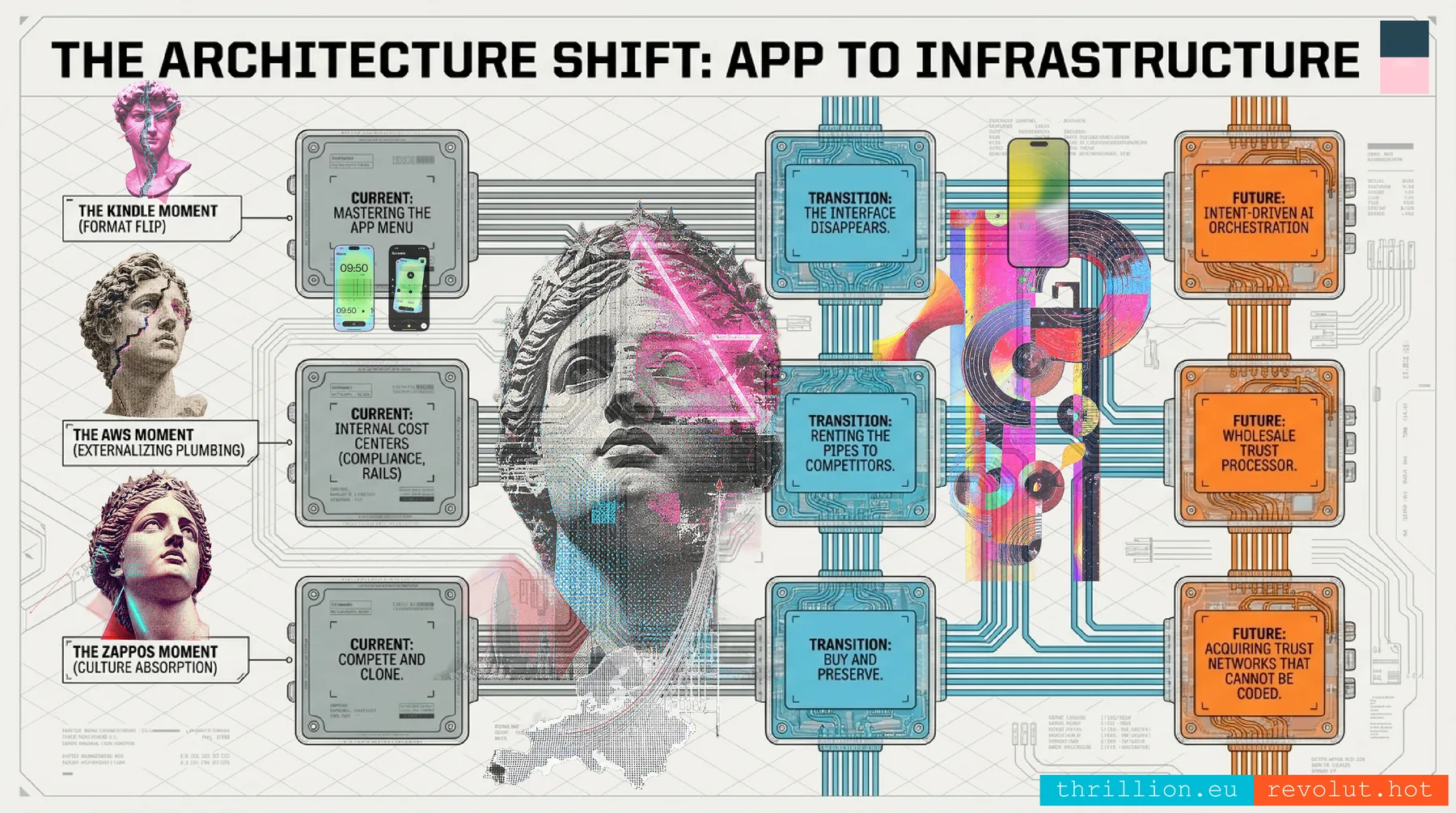
The Kindle moment

The incumbent's success in the old format is exactly what blinds it to the day the format flips. Revolut is superb at selling “print.”

AMAZON MOMENT / 02

The AWS moment

The boring plumbing built for your own use becomes a bigger business than the store. The single question this company isn't asking loudly enough.

AMAZON MOMENT / 03

The Zappos moment

The culture-reshaping acquisition of a thing you couldn't build — and let stay itself. Nothing in Revolut's history says it knows how.

One Kindle-moment and one AWS-moment
from a genuinely different kind of company.

The thing in the way isn't capital, talent or the market — it's a self-image two years out of date.

02The operator's case · five businesses hiding inside the bank · What if? ·
The AWS question

Which piece of plumbing you built
for yourself is secretly bigger than you?

Five expensive pieces of infrastructure, built to serve Revolut's own customers, currently pure cost. Each is one decision from a new B2B line — copying a proven model, on an asset already on the books, for near-term margin, in a window open right now. The fifth — PRAGMA — was promoted here from the moonshots once the news and updates came in.

Claim discipline. Every assertion carries its epistemic status — Factpublic record Inferencereasoned from it What-ifspeculation, labelled
What if? · 01 · The Bank for Banks
The [Digital] Bank for [Digital] Banks

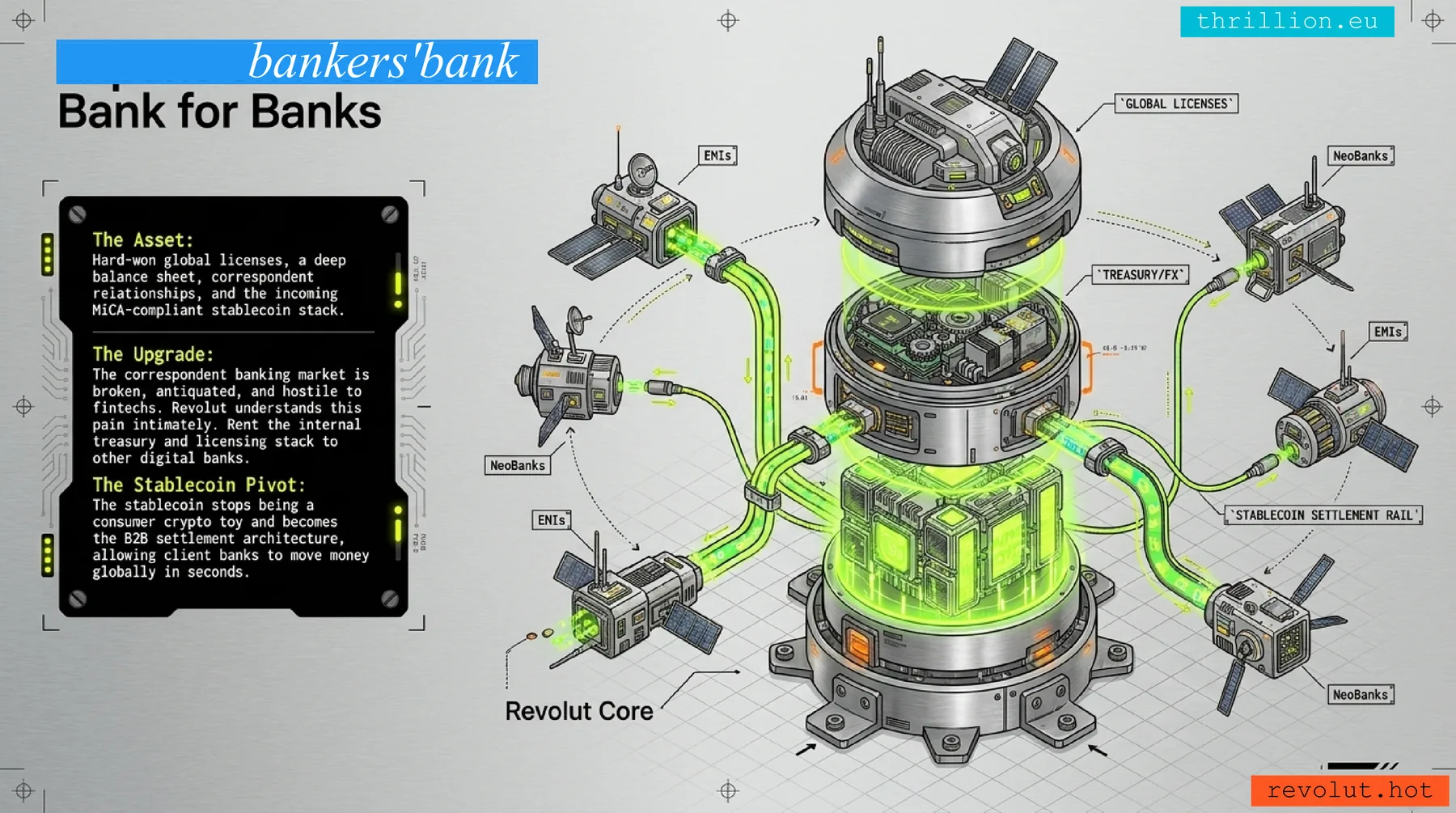
Don't recycle fintech client money into fintech capital. Package regulated infrastructure — safeguarding, agency banking, settlement, treasury and asset-backed credit — for the digital banks, EMIs, IFEs and PSPs that need bank-grade plumbing but don't want to become banks.

Build firstB2BInference
AssetA live UK bank, a pending US national-bank application (OCC, filed Mar 2026) and an EU platform — plus treasury, FX, and a crypto and imminent stablecoin stack.
CopyA BaaS-and-correspondent bank for the fintechs, EMIs and PSPs Revolut used to be one of. Stablecoin-based settlement is already a visible trend, so Revolut enters as a fast-follower with better distribution — not a pioneer taking arrows.
Why nowTougher FCA safeguarding (a CASS-style trust regime is coming); fintechs need settlement, HQLA and balance-sheet partners. The corner is broken and uncontested.
RevenueMake money from trust, movement and risk — in that order: NII on operating balances, flow fees, warehouse credit yield, platform/API pricing.
Product stack — build what supervisors already understand
01
Safeguarding & agency

Named accounts, reconciliations, trust mechanics, reporting for EMIs/PIs.

02
Rails & settlement

Faster Payments, SEPA, cards, ACH/wires, virtual accounts.

03
Treasury & liquidity

Cash concentration, HQLA, intraday funding, FX liquidity.

04
Asset-backed credit

Receivables, card advances, warehouse lines at arm's length.

05
Compliance data

Ledger proof, audit packs, monitoring feeds, source-of-funds.

Evidence hooks Fact
  • UK banking licence granted (Mar 2026); US de-novo national-charter filing with the OCC (Mar 2026)
  • Revolut already runs US accounts & payments via Lead Bank (Kansas City); FCA finalising CASS-style safeguarding
  • MiCA stablecoin rail already live for 1:1 conversion
Risk boundary No-go
  • Safeguarded client money is not the EMI's capital — never count it as own funds
  • No circular structures that inflate regulatory capital
  • Capital and client money stay conceptually separate, always

Correspondent banking only works from the US now. Get the charter right and you don't just win America — you unlock the bankers' bank.
What if? · 02 · Digital Identity
Revolut ID — from SSO to the verification rail

68 million bank-grade KYCs, already paid for and used exactly once. Sell the consented proof of a real, verified human — not the person.

B2BSign partners '26Digital IdentityFlagship
Asset68M individuals + 767K businesses verified to a banking KYC standard across dozens of jurisdictions. The most under-exploited asset on the books.
CopyPersona, BankID, itsme, Yoti — reusable bank-grade identity is proven, not pioneered. Ribbit Capital argued years ago that banks are its natural issuers.
BeachheadVisa & travel-document outsourcing (VFS Global, TLScontact, BLS) — a large, fee-bearing, unloved verify-collect-submit industry. Compete, or be their modern second layer.
Why nowIn an AI era drowning in synthetic identity and deepfakes, proof of a real, bank-verified human is becoming one of the most valuable commodities online.
VFS Global, TLScontact, BLS partner (or rival) — a P&L line: high-margin revenue on identity you've already verified. Needs a BD muscle Revolut under-indexes on.
    World ID rival →
  • pKYC / KYCC / KYE
  • elections / voting
  • decentralised identity
  • metastate
  • AI-agents IDs
What if? · 03
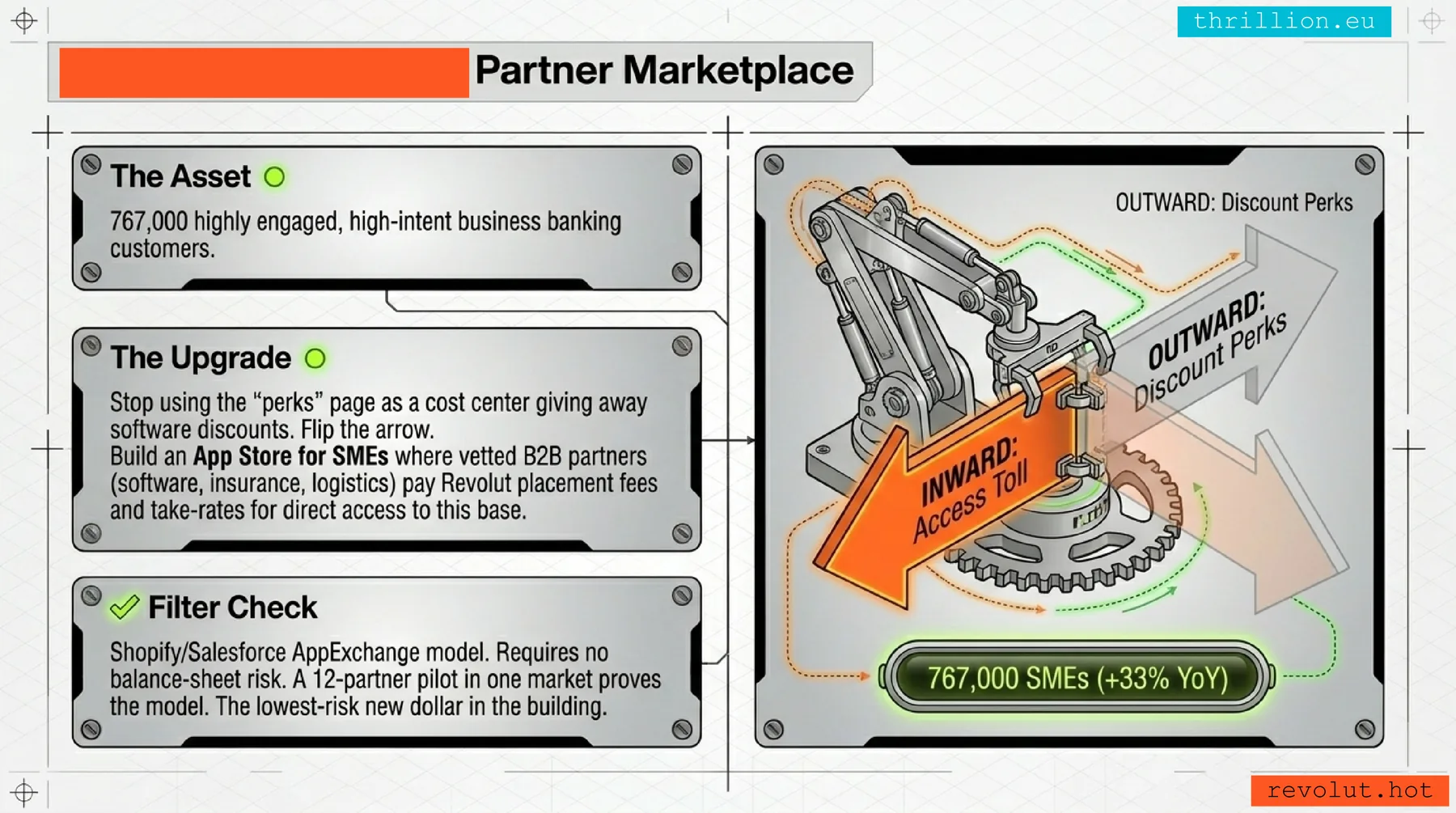
The Partner Marketplace

Business-clients needs more sales, not discounts. Flip the perks page. The asset isn't the discounts you hand out — it's access to 767,000 businesses other companies will pay to reach.

Pilot this quarterSMEFlagship
Asset767K businesses — the fastest-compounding part of the machine (+33% in a year, business revenue up ~75%) — opening the app every day.
CopyShopify App Store, Salesforce AppExchange, Amazon Marketplace, Apple App Store: “Own the customer relationship, then rent shelf space.”
Why nowPour a monetisation layer on your fastest-growing asset. Cheapest to test — a twelve-partner pilot in one market tells you almost everything.
MarginTake-rate / placement on other people's products. No balance-sheet risk, minimal regulatory friction — the lowest-risk new dollar in the building.
Honest caveat — marketplaces live or die on curation. A junk-filled pay-for-placement page corrodes the very SME trust that makes the asset valuable. The discipline must be editorial, not just commercial.
What if? · 04
The Offline-to-Online Wealth Roll-up

Buy profit, not brand. Roll up ageing independent advisers; re-rate their margins by dropping your own technology onto their creaky back offices.

18-month playM&AInference
VacuumCoutts pushed its bar toward £3m; the old private banks abandoned the mass-affluent. Revolut's £500k unit slots into the gap — “Private Banking 2.0.”
AssetA just-launched private-banking unit (£500k threshold, FCA approval May 2026; wealth revenue +31% to £663m / $876m in 2025; reported Blackstone tie-up for HNW clients) with capacity to fill.
The playAcquire recurring advisory fees + sticky AUM from IFAs with no succession plan; automate admin, reporting, compliance, servicing = “evolution, not revolution” roll-up.
Why nowOrganic HNW acquisition is slow; a roll-up fills the unit in eighteen months — and digital-first cost-to-serve makes premium profitable at lower AUM.
The vacuum Inference
  • The UK is full of profitable IFA practices — loyal HNW clients, recurring fees, sticky AUM, no succession plan: annuities for sale at modest multiples
  • Full UK banking licence (PRA, Mar 2026) protects deposits and unlocks lending
Risk boundary No-go
  • It's M&A with premiums + people-integration — Revolut's least natural muscle
  • Buy it like a bond for the yield.
Framed as buying profit, it turns a just-launched private bank into a serious one inside eighteen months.
What if? · 05 · an 'AI correction'
There's a big difference between an AI company and a company that spends a lot on AI.

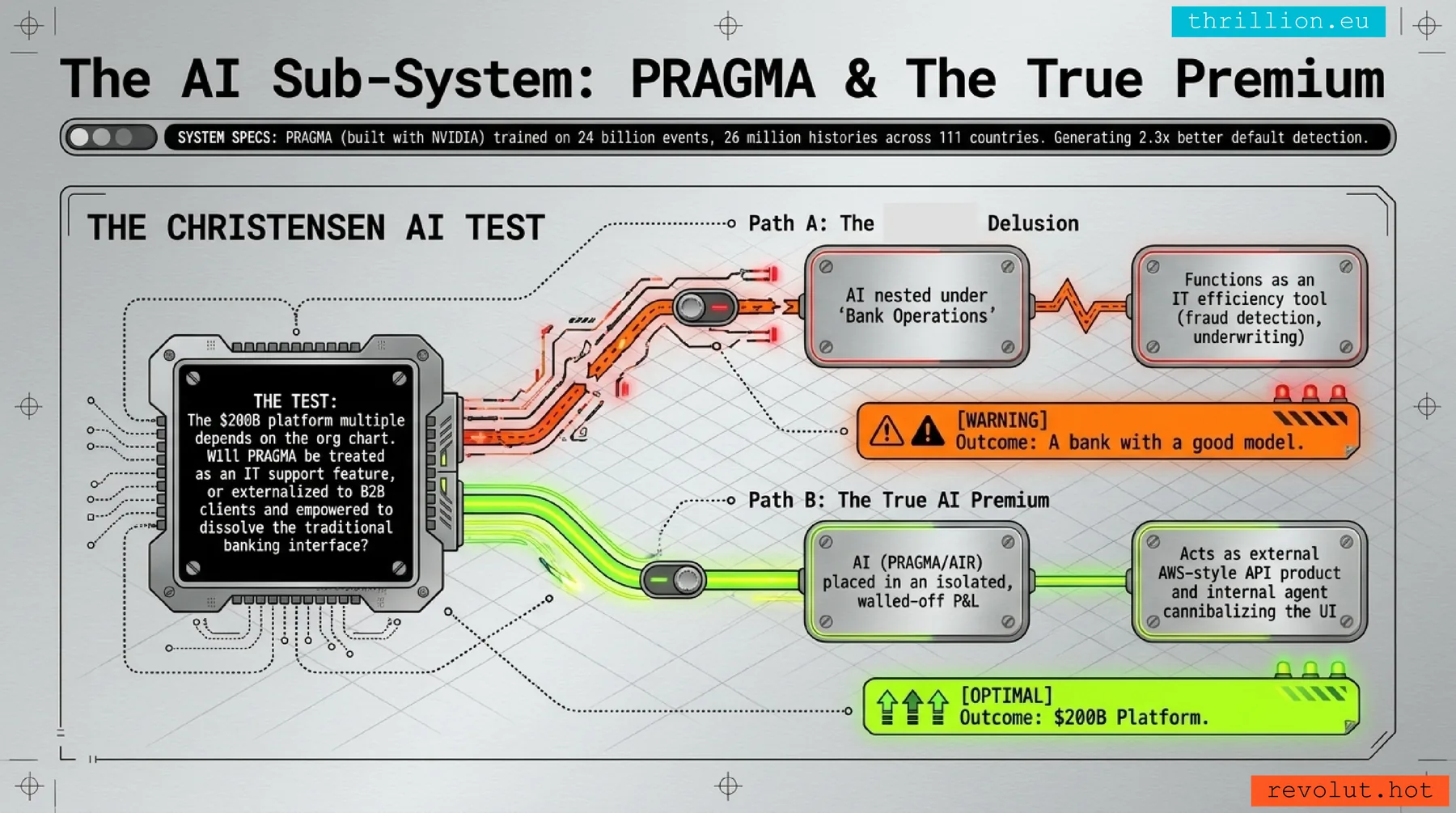
The fifth pillar — promoted out of the moonshots once the facts came in. An in-house financial foundation model, built with Nvidia and already in production, serving Revolut's own underwriting, fraud and ops — and sellable as external B2B infrastructure.

PRAGMA — the intelligence railAIFact
AssetPRAGMA — a financial foundation model trained on ~24bn events across 26M customer histories in 111 countries. On top sits AIR, the in-app assistant shipped to 13M UK customers (Apr 2026). Co-published with Nvidia; runs on hundreds of their GPUs (Nebius infra).
In productionReported gains on the order of ~2.3× better default detection and ~65% more fraud caught at higher precision — already lifting live credit, fraud and lifetime-value models.
CopyThe AWS move: take the internal model to market — fraud-and-risk scoring, reusable behavioural embeddings and KYC-monitoring, sold to the very fintech/EMI segment of the bank-for-banks and folded into the verification rail.
Why nowThe single most un-copyable asset in the book: billions of labelled financial events that no competitor — and no merger — can buy. Near-term pure margin; medium-term a B2B line.
PRAGMA is a real, owned asset and the textbook Kindle/AWS moment. It belongs with the operator pillars, not the daydreams — the fifth invoice waiting to be issued. The (NVIDIA) Innovator's Dilemma: is PRAGMA/AIR walled off with its own P&L, free to disrupt the bank (Christensen) — or externalised as infrastructure?
Bar 1 — cleared Fact
  • A real model in production, not a renamed IT department
  • A named Nvidia collaboration — co-published, hundreds of GPUs
Bar 2 — the board question What-if
  • Is PRAGMA/AIR walled off with its own P&L, free to disrupt the bank (Christensen) — or externalised as infrastructure (AWS)?
  • Or org-charted beneath the bank as a feature? The $200bn-as-an-AI-company premium lives past this bar.
03Signals, mappedfilter by tier
Roster

My original hypotheses, sorted the way the analysis sorts them: flagship assets ready to monetise, the playbook to enable them, the thesis that frames them, and the labs moonshots — genuinely loved, fenced off so they can't contaminate the five that pay.

01The trillion 'blockbuster' thesisEurope's answer may already exist — and not admit itThesis 02Underrated — company & founderUnder-imagined, not under-valuedThesis 03The NounFrom “the Simple bank for…” to “the Revolut of…”Thesis 04The motto“It's always impossible. Until it's done.”Thesis 05Revolut ID — re-usable digital identity68M bank-grade KYCs, sold as a railFlagship 06The reinvented ATMBiometric hub · card&ID printer · VTM-kioskLabs 07AI mini-station + DePINA distributed, sovereign data centreLabs 08PRAGMA — the intelligence railThe foundation model — promoted from Labs to a pillarFlagship 09Partner MarketplaceCharge partners for access to 767K SMEsFlagship 10IOU — reinventing the debt note…and, eventually, moneyLabs 11Stablecoins + Correspondent BankingThe settlement rail, not a consumer toyFlagship 12Bankers' bankLiquidity & paid-in capital for fintechsFlagship 13Offline Brand&Experience O2O-Soul'No branches' ≠ 'no physical presence'. Personal touch: pop-ups, brand 'theatre' showrooms, 'what if it buys WeWork' brainstormingLabs 14The MachineStoronsky as the operating systemThesis 15Second-mover: ceiling or strategy?When copying stops being enoughThesis 16M&A, 'Size matters' & the competitors' 'Anti-Revolut'The chasing pack's only merger logicThesis 17'Revolut Mafia' / ESOP bankingLiquidity for paper-rich option holdersLabs 18Wealth 'offline-to-online' roll-upBuy IFA cash flow, upgrade the marginFlagship 19Revolut in the USThe charter — and how not to blow itPlaybook
04The enabling move · scar tissue
Where the author's scars beat his ideas

How not to blow the US —
for the fourth (?) time.

· one beaten is worth two unbeatens ·
Don't blow the US charter

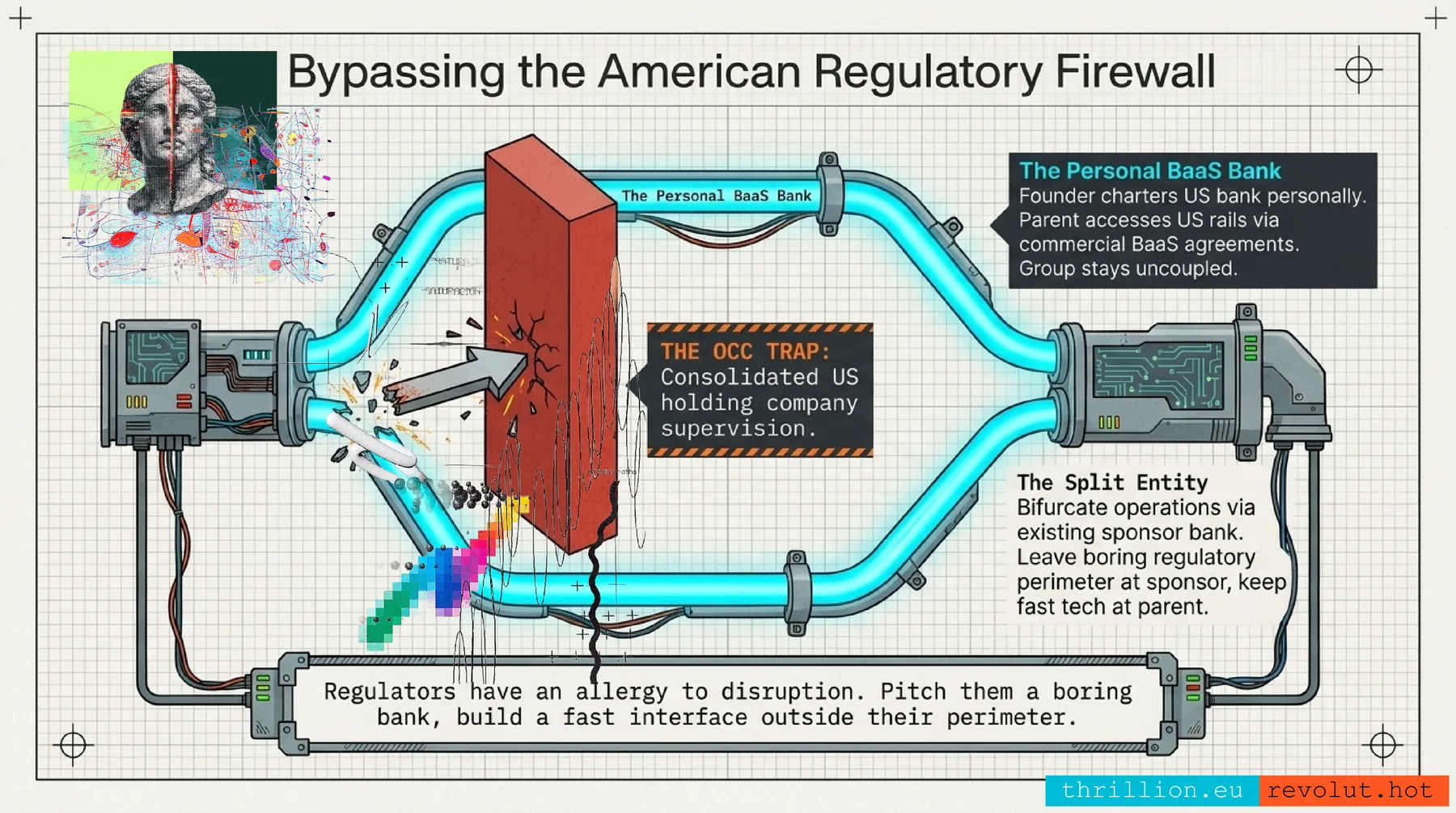
The Bank Holding Company Act drags the whole group into US consolidated supervision. That — not a lack of quality — is what bit the prior three (?) attempts.

PlaybookRegulatory
The trapA foreign group seeking a US charter pulls UBO scrutiny, compliance harmonisation and consolidated reporting onto the entire empire — not just the American entity.
Way AA personally-held some kind of BaaS bank (the easier foreign-individual path) that serves Revolut as one ordinary commercial B2B-client — keeping the perimeter clean.
Way BA staged investment into a BaaS-ready bank — Revolut already runs US accounts via Lead Bank (Kansas City); other names: Column, Vast (Greg Kidd), possibly B2 Bank. Learn it from inside; deepen over time.
The pitch'A good bank we'll respect and barely change — plus a small team and modest tech for a few new business clients.' (The client is you.) Cut the entity into a boring banking half and a fast technology half.
Why this is the author's own card — the value here isn't an idea anyone could have had. It's two and a half years and a real US charter (IFE-065), plus the scars of Robinhood's experience failed run. Maps like this come from minefields, not terminals — for one beaten, two unbeaten are given.
05The glass, honestly measured · the bear case
A fair trial has two sides

The strongest case
against the trillion.

Every serious book about a company earns its credibility in one place: the chapter that makes the strongest case against. The core fear — the very thing that makes Revolut great at being a bank may make it incapable of becoming anything more, and the next two years are when the bill comes due.

PLANK / 01

The regulator doesn't care that you're brilliant

Five years and three strategies to be a bank in America; a three-year UK wait that became a press humiliation. The friction is structural, and it cuts straight at the thesis.

PLANK / 02

The flywheel throws shrapnel

The engine that produces blistering execution also produces recurring “YES-man culture”: process-worship scales execution beautifully and entrepreneurship-in-residence terribly.

PLANK / 03

Second-mover advantage as a ceiling

Copy the surface — screens, flows, feature list — without the soul underneath, ship because the machine demands it, then quietly retire it. Survivable for a bank, fatal for a platform.

PLANK / 04

Key-man risk: 'Elon Musk effect'

Nik Storonsky as the main asset of Revolut, and... New co-pilots required.

PLANK / 05

'Size matters,' both ways

Priced for a platform outcome while being, today, a superb bank. The valuation that flatters you on the way up disciplines you on the way down.

PLANK / 06

The allergy to outsiders

A culture that prizes the home-grown and is cool to what it didn't build — which interacts badly with the acquisitions the thrillion path requires.

Oliver Cromwell
at the court

Too competent to dismiss, too other to fully admit. The darkest version of the bear case is simply that this never resolves — that merit never beats membership.

06Labs — the daydream drawer +
fenced on purpose What-if

The moonshots I love
and can't yet defend.

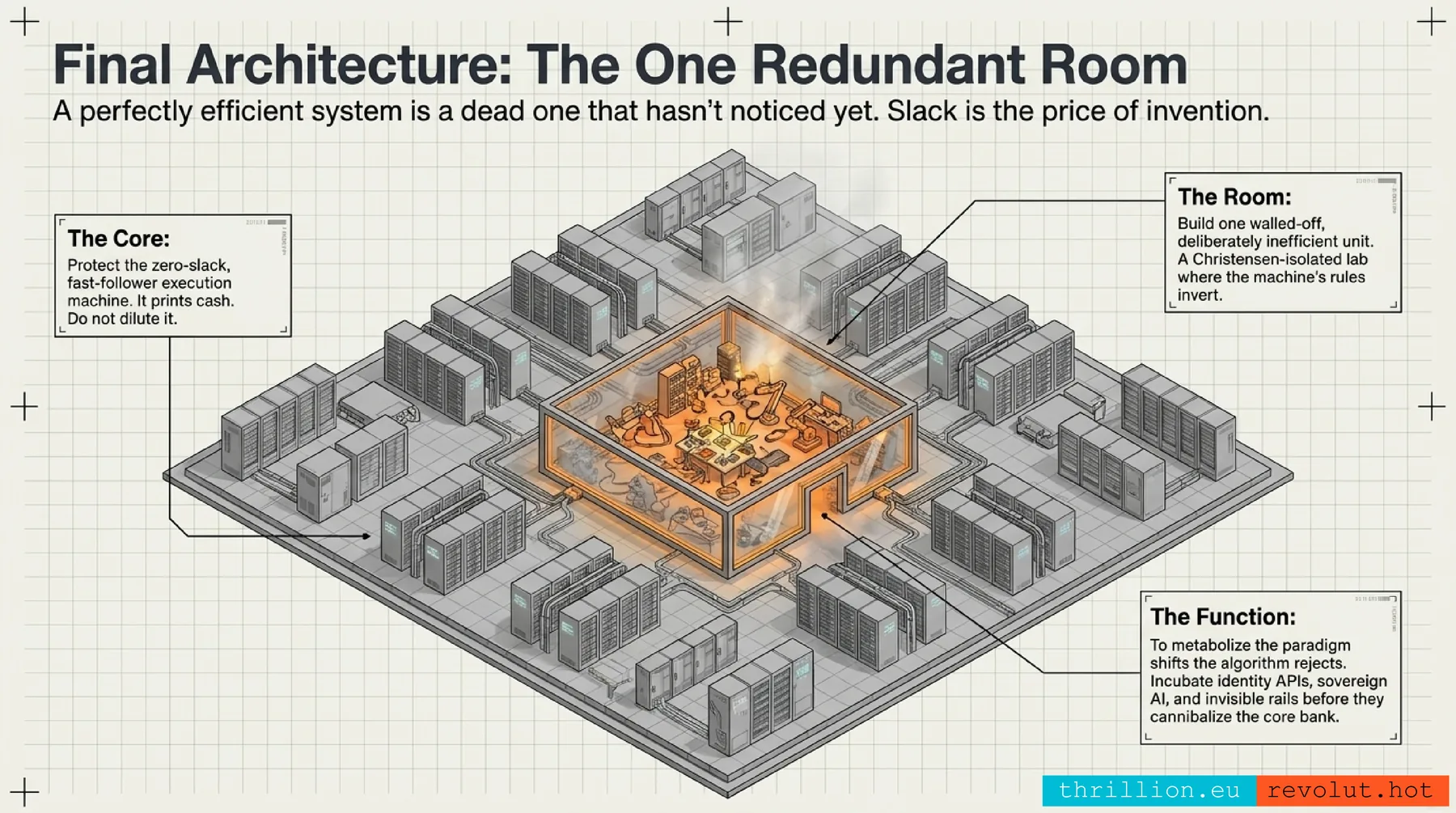
The most persuasive thing an idea-person can show an operator is not a great idea — it's the judgment to know which great ideas aren't yet investable. Everything here is genuinely exciting, genuinely the author's, and genuinely fails at least one filter today. Fund it after the five flagships, never instead.

IDEA 06 · hardware · Biometric hub x VTM

The reinvented ATM

A machine that prints bank cards on the spot (for other digital banks too — a new fee line), doubles as a biometric kiosk (for VFS Global and similar partners and clients), someday a polling booth. Fenced: sub-scale hardware that doesn't move a $200bn needle.

IDEA 07 · Revolut's AI mini-PC & DePIN

AI mini-station + distributed compute

Sell prosumer AI PCs on credit, pre-integrated with DePIN so they earn from day one; Revolut becomes a sovereign, distributed data centre. Fenced: by hands-on testing, a 2028–2030 concept in a 2026 reality.

IDEA 11 · Revolut's own stablecoin

The currency-basket stablecoin

A privately-issued echo of the IMF's SDR, for the multi-currency world Revolut already lives in. Closest to investable — promote it into the Bank for Banks settlement rail first.

IDEA 10 · IOU

IOU — reinventing the debt note

Document personal & SME debt properly, track every obligation on one screen, then make them digital and transferable — quietly reinventing money. Fenced: regulatory minefield, no near-term P&L.

IDEA 13 · O2O

'No branches' ≠ 'no physical presence.'

Brand theatre à la Nothing, Gentle Monster, Dover Street Market. Fenced: for a cost-first operator this reads as marketing spend — defensible only as one cheap, time-boxed pop-up.

IDEA 17 · Secondary market · HR

Revolut for ESOP

Non-recourse liquidity for paper-rich option holders (à la Secfi / EquityBee / ESO Fund): borrow against shares to exercise and cover AMT, with post-IPO liquidity flowing straight into Revolut Wealth. Fenced: the pain eased pre-IPO, and tainted-equity risk (the Robinhood / OpenAI lesson) means it must be sanctioned or structured as debt — not core, not leverage.

07The memo — what to do Mondaythe one page that matters

If you read nothing else,
read this page.

Short, profit-first, no romance. Three new B2B revenue lines that monetise assets you've already paid for, plus one thing to get right — ordered by speed-to-cash.

1

Partner Marketplace — ship the pilot this quarter

Charge vetted partners for access to your 767,000 businesses. Take-rate / placement, not balance-sheet risk. The lowest-risk new dollar in the building; a twelve-partner pilot in one market tells you nearly everything.

Asset · the Business baseCopy · Shopify App StoreWhy first · cheapest to test
2

Verification Rail — sign the first partners this year

Sell reusable, bank-grade identity on the 68 million KYCs you've already completed. Beachhead: visa-outsourcing. Sell it as “high-margin revenue on identity you've already verified” — not “worth more than the bank.”

Asset · 68M completed KYCsCopy · BankID / itsmeGap · needs a BD muscle
3

Don't blow the US — the move that enables #2 and #4

The Bank Holding Company Act drags the whole group into US supervision — that's what bit the prior attempts. Insulate structurally (a personally-held BaaS bank, or a staged stake in a BaaS-ready one), pitch the regulator their way, and cut the entity into a boring banking half and a fast tech half.

Structure · individual, not groupUnlocks · the bank for banks
4

Bank for Banks — build it through the US charter

Rent your licences, treasury, FX and stablecoin rail to the fintechs/EMIs/PSPs you understand best — with your stablecoin as the settlement rail, not a consumer toy. The single biggest new B2B pillar available to you.

Asset · licences + treasury + cryptoCopy · stablecoin settlementPrereq · world-class compliance
+

Productising PRAGMA — the foundation model you've already built

— is the opposite of a daydream: a real, owned, un-copyable asset. Sell its fraud/risk scoring and KYC-monitoring into the same fintech segment as #2 and #4. Treat it as the fifth invoice, not a fenced idea.

Asset · PRAGMA + AIRCopy · the AWS pathWhy · nobody can buy your data
The unsentimental punchline —

Filter this whole thing without mercy and notice what survives: only the moves where Revolut already owns the asset and merely has to monetise or execute it. Not one beloved moonshot makes the cut. And the one place the contribution isn't an idea you could've had anyway is #3 — the US scar tissue. It's making sure the charter that unlocks half this memo doesn't die of the wrong sentence for a fourth (?) time.

08The container may be smaller than the thing inside itdisrupt yourself

Storonsky next / a thought experiment

If a company can outgrow its self-image, so can a founder. The operating system Storonsky embodies — cold, process-obsessed, allergic to vanity, relentless over long horizons — is a more general-purpose engine than “run a bank” requires. The honest version of this chapter is one open question left open, out of respect: the most underrated asset in the whole story may be the founder's own unspent range. Storonsky, next? What he does with it is his to decide.

The anti-Revolut / a thought experiment

In public markets, size itself attracts capital — attention and the institutional bid flow disproportionately to the biggest, best-known names, almost regardless of product quality. Individually no chaser matches Revolut's scale, breadth or multiple; together, some could manufacture the one thing none has alone — narrative gravity. The best defence is to make assets un-catchable before the pack realises it must merge.

Coalition logic What-if
  • Global B2B OS — acquiring + banking + AI accounting
  • European champion — combine the SME-banking field
  • Capital symbiosis — a lender plus a bookkeeper
Why Revolut rarely buys Inference
  • NIH 'Yandex\Nebius syndrome' — allergic to outside teams
  • Acqui-hire for licences, then dissolve into the app
  • Offence = defence: the un-catchable assets are the moat
The book behind the blueprint · June 2026
Europe's First Trillion-Dollar Startup?

Revolut, not?

Revolut, hot. An outsider's operator case for the most underrated company in Europe, and the most underrated founder in it — by Slava Solodkiy, founder of Arival Bank (US charter IFE-065) and sreda.ventures, author of the viral Revolut Mafia research.

On the motto: “It always seems impossible until it's done” is a line the internet hands to Nelson Mandela, though no one has found him saying it. It's left misattributed on purpose — the most Revolut sentence ever written by no one in particular: a slogan that became true only in retrospect.

Read it

Hardcover ISBN 9798184250809 · Paperback ISBN 9798184250588 · eBook ASIN B0H6K7FR4K / ISBN 9798235275867 · DOI 10.6084/m9.figshare.32782464.

The honest disclosures
  • Nobody asked for this. Not Storonsky, not anyone at Revolut. Unpaid, uncommissioned, not pre-cleared — that's the price of writing from outside the building.
  • Not a shareholder. When the door to an early round was open, the author didn't walk through it. There's no position here to talk up.
  • Knows the man a little, the ecosystem a lot. Private material stays private — no screenshots, no family, no politics. That boundary is what lets the rest be honest.
  • On the FT. The FT once asked whether Europe could build its first trillion-dollar start-up; this asks the same question in a different mood. Ian Hogarth's essay concerns Europe's tech gap broadly, not Revolut — and nothing here is an endorsement, real or implied.